

The Polar Explorer Week

An advanced 6-day polar training camp in Northern Norway for aspiring polar explorers, athletes and winter travelers who want to operate at expedition level.

Take your winter travel skills to the next level

The Polar Explorer Week is designed for people who already have winter travel experience and want to step toward true expedition readiness. This is not a beginner course. You are expected to arrive with solid cold-weather skills and the ability to ski with a pulk. During the week, travel days become longer, systems must be cleaner, and you take increasing ownership of navigation, pacing, camp routines, and risk management.

The goal is clear: move beyond basic competency and become semi-expedition ready in real Arctic conditions.

Training is based at Namdalen Wilderness Lodge in the Pasvik Valley of Arctic Norway. From this remote basecamp, you train in real winter conditions while having a structured and supportive environment for learning.

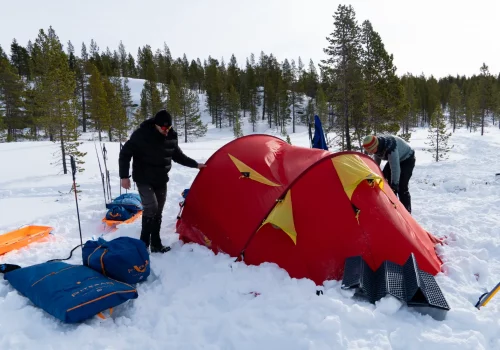
During the 6-day camp, you learn how to ski efficiently with a pulk, manage clothing and moisture in cold weather, set up and secure a snow camp, use stoves safely, and navigate in winter terrain. You also practice pacing, route planning, and basic risk management. As the days progress, these skills are applied during longer ski days and structured snow camp routines, helping you move from understanding individual techniques to operating with confidence in real Arctic conditions.

The camp is led by Jon Fearne, founder of E3C, one of Europe’s leading endurance and adventure performance coaches. Jon has coached remarkable athletes, including Monet Eliastam, the first American woman to ski unsupported to the South Pole, Preet Chandi on her record-breaking ski to the South Pole, Atlantic rowers, the first female team to complete Heroes of Telemark, the Antarctic Fire Angels (featured in an ITV4 documentary), World Endurance Mountain Bike champions and the YouTube/Natgeo presenter Eva Zu Beck. His coaching focuses on building clean systems, consistency, and clear decision-making. Jon can share the secrets that set these athletes apart, delving into the mental and physical training that prepared them for their extraordinary challenges. With over 28 years of industry experience, Jon will guide you on how to best prepare for any challenge you choose to undertake.

Camp highlights

  • Independent camp builds in real Arctic conditions
  • Athlete-led navigation and route ownership
  • Realistic “bad day” simulations
  • Scenario-based decision-making under fatigue
  • Structured expedition readiness assessment and personal progression plan

Good to know

  • This is an advanced camp for participants with prior winter travel experience.
  • Accommodation is at Namdalen Wilderness Lodge in the Pasvik Valley.
  • Detailed preparation guidance and a full kit list are provided before arrival.
  • The week is progressive and becomes increasingly athlete-led with more responsibility over time.
  • If you are unsure whether this level fits, we can review your background before you apply.

Date

28 February - 5 March 2027

Duration

6 days

Group size

6-8 people

Location

Pasvik Valley, Northern Norway

Skill level

Experienced (prior winter travel required)

Accommodation

Remote cabin & snow camp

How the week is structured

This week follows a progressive structure, with each day increasing in distance, responsibility, and complexity. Travel days are longer than in the Intro Camp, and systems are expected to function efficiently under fatigue. Participants take greater ownership of navigation, pacing, camp decisions, and risk management. As the week unfolds, instructor input decreases and athlete responsibility increases, leading toward realistic expedition-style travel and team operation. The goal is to develop the ability to operate confidently and independently during multi-day Arctic travel.

Theme: From “learning” to “operating”

  • Refresher on key skills from Week 1
  • Quick kit audit + load increase
  • Weather & avalanche awareness briefing
  • Athlete-led layering decision game
  • Packs/pulks checked for efficiency and redundancy

Practical

  • 10–12 km moderate ski with coaching corrections
  • Break-timing challenge (minimise heat loss)
  • Fuel planning for the week (student-led)

Mindset

Your job now is to run your system, not just learn it.

Theme: Precision movement & route ownership**

  • 14–18 km ski with pulk
  • Micro-navigation: bearings, handrails, attack points
  • Snow texture reading (wind slab, crust, powder)
  • Team rotation: navigator, pace-setter, welfare lead

Drills

  • Controlled descents with pulk
  • Layer-change protocol on the move
  • Tactical snack strategy (fat-rich cold-weather fuelling)

Evening

  • Snow-wall construction for wind protection
  • Team debrief using structured communication

Theme: Athletes take over**

  • All travel logistics student-led
  • Camp selection assessment: wind, drift, safety
  • Tent build & anchors with minimal instructor input
  • Advanced stove management (melting efficiency, wind screens)

Pressure Drill

  • Time-limited camp build → simulate late arrival fatigue
  • Build a functional shelter in deteriorating weather

Mindset

Fatigue exposes the quality of your systems.

Theme: Endurance, resilience & energy management**

  • 18–22 km ski (terrain dependent)
  • Athletes lead pacing and route selection
  • Tactical breaks enforced (short, efficient, non-negotiable)
  • Managing sweat: drying strategy during movement

Scenarios Introduced

  • Lost pole basket
  • Frozen zip problem
  • Layer freezing from sweat → decision-making consequences

Evening Workshop

  • Expedition problem-solving & self-rescue thinking
  • Conflict management & emotional regulation

Theme: When everything is harder**

  • Simulation: whiteout navigation
  • Wind strategy: shelter use, team spacing, communication
  • Emergency camp build
  • Thermal emergency drill
  • Stove failure → build a fuel/heat backup plan

Short Travel Segment

  • Focus: efficient movement in challenging conditions
  • Route choice in low visibility
  • “If this was real, what do we do next?” scenario discussion

Mindset

Tough days reveal real expedition readiness.

Theme: Reflection and consolidation

  • Break down solo camp
  • Independent travel back to base
  • Return to basecamp (around lunch)
  • Debrief & feedback (group and individual)

Outcome:

You leave with a clear understanding of how you operate independently in Arctic conditions.

Step beyond basic competency toward semi-expedition ready.

By the end of the week, you will not only refine the technical skills required for winter travel, but also learn how to apply them consistently under fatigue and pressure. The focus is on building reliable systems rather than relying on toughness. Throughout the camp, we emphasise autonomy over instruction, precision over power, and endurance built through consistency rather than heroics. Decision-making is trained as a skill, not a reaction, and small daily systems are used to create long-term performance. You will practice team behaviour, emotional regulation in cold environments, and structured self-sufficiency. The goal is to leave with clear routines, efficient systems, and the confidence to operate safely and effectively in demanding Arctic conditions.

Core development areas are:

Who this camp is for

This camp is for participants who already have winter travel experience and want to advance.

It is a strong fit for:

  • Experienced winter hikers or ski tourers
  • Expedition hopefuls preparing for Greenland or other Arctic crossings
  • Returning polar trainees who want longer days and higher responsibility
  • Athletes who want structured feedback under realistic Arctic stress

You should:

  • Be in good physical condition
  • Be comfortable skiing several hours per day with a pulk
  • Be prepared for full days outdoors in cold and wind
  • Be willing to take responsibility within a team

If you are unsure whether your level fits, we can review your background before application.

"You’re now training like a true polar athlete — not just surviving the cold, but mastering it."

Train in real Arctic conditions in the Pasvik Valley

The camps take place in the Pasvik Valley near Kirkenes in Northern Norway, approximately 400 km above the Arctic Circle. The Pasvik Valley forms the northwestern edge of the Siberian taiga, the largest forest ecosystem on Earth, stretching from Finland through Norway and into Russia. This is not a resort setting or controlled training environment. It is a remote Arctic landscape with sustained cold, long winter days and limited infrastructure.

The balance is intentional: real environmental exposure combined with professional coaching. Skills are developed and tested in conditions that reflect actual Arctic travel, giving participants a realistic understanding of what polar movement and winter camping require.

Your base camp at Namdalen Wilderness Lodge

Basecamp is Namdalen Wilderness Lodge, a true wilderness property about 40 minutes outside of Kirkenes. In winter, the lodge is only accessible by snowmobile, skis, or snowshoes. It offers a true Norwegian cabin experience. The lodge is rustic and simple, yet deeply connected to the nature around you. It consists of several traditional buildings and includes a wood-fired sauna. There is no running water on the property. Water is sourced from a well, and showering takes place in the sauna. This setup is part of the experience and reflects the realities of living and operating in remote Arctic environments.

The lodge serves as both a starting point and a place to reset. Depending on the program and weather, you will spend time here preparing equipment, learning systems, and recovering between field days. From the lodge, you move directly into the surrounding wilderness.

Led by Jon Fearne, proven Polar Expedition Coach

The camp is led by Jon Fearne, an experienced polar expedition and coach founder of E3C (Endurance, Exploration, Excellence Coaching). Jon has prepared multiple successful South Pole solo expeditions, including Monet Eliastam, Preet Chandi and the Antarctic Fire Angels, and has worked with explorers such as Eva Zu Beck. His coaching approach focuses on building reliable systems rather than relying on motivation or toughness. He emphasizes consistency, disciplined routines, and decision-making under fatigue — the same principles that support successful polar expeditions.

 With over 28 years of industry experience, Jon will guide you on how to best prepare for any challenge you choose to undertake. For beginners, this means learning the right habits from the start. For more experienced participants, it means refining systems and identifying weaknesses before they become problems on larger objectives. 

Meet your guides on the ground

You will be supported by a team of experienced guides who live and work in the Kirkenes area year-round. We know the terrain, the conditions, and how quickly things can change. Throughout the camp, we are there to guide, support, and create a safe environment where you can learn with confidence.

Practical information

Difficulty

  • This is a physically and mentally demanding week. Travel distances are significant and responsibility increases throughout the program.
  • You should be able to ski for several hours while pulling a pulk and manage your clothing, nutrition, and energy in cold conditions without constant supervision.

Included

  • Professional coaching by Jon Fearne (E3C)
  • Transport from Kirkenes to Namdalen Wilderness Lodge
  • Accommodation at Namdalen Wilderness Lodge
  • All meals, snacks, coffee and tea
  • Structured 6-day training program
  • Basic expedition equipment (skis, pulks, tents and shared group gear)
  • Structured feedback and daily coaching guidance


A detailed kit list is provided before the camp. Personal clothing and certain individual equipment items are not included.

Included learning materials

Participants receive:

  • Daily movement metrics (pace, distance, energy strategy)
  • Personal system audit (strengths & weaknesses)
  • Expedition readiness score
  • Next-step training plan (Greenland, South Pole prep, or Solo course)
  • “Cold Decision-Making Framework” PDF
  • Navigation progression workbook

What to bring

A detailed equipment list will be provided after booking. Below is a general overview of what you should expect to bring:

  • Warm base layers such as merino underwear
  • Down jacket
  • Windproof shell jacket
  • Warm hat, gloves and spare gloves
  • Warm winter boots suitable for Arctic conditions
  • Headlamp
  • Reusable water bottle
  • Sunglasses

Take the next step in your polar journey

Fill out the form to get started. This camp is designed for those who already have experience and want to build more independence in winter travel. After you send your request, we will get in touch for a relaxed conversation. This helps us understand your background, goals, and expectations, and ensures the camp is the right fit for you. There is no obligation at this stage. We will guide you through the next steps once you are ready.

I have read the privacy policy.

Other camps that you might like

Introduction to winter travel & camping

A beginner-friendly Arctic training camp that teaches the fundamentals of winter travel, snow camping, and expedition systems.